
Percentages are used in many everyday situations. You may need to calculate a percentage when checking a discount, comparing prices, understanding a test score, calculating a tip, or working out how much something has increased or decreased.
The good news is that calculating a percentage is simple once you understand the basic formula.
In this guide, we will explain how to calculate a percentage step by step, with simple examples.
What Is a Percentage?
A percentage is a way of expressing a number as a part of 100.
The word “percent” means per hundred.
For example:
- 25% means 25 out of 100
- 50% means 50 out of 100
- 75% means 75 out of 100
- 100% means the whole amount
So, if 25 out of 100 students passed a test, the passing percentage would be 25%.
Basic Percentage Formula
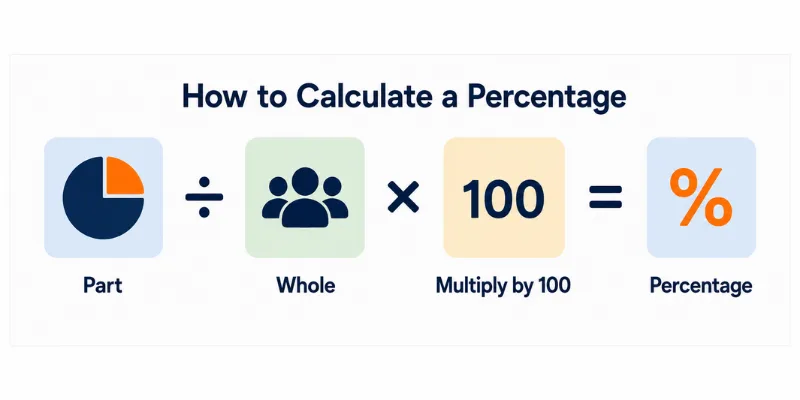
The basic formula is:
Percentage = (Part ÷ Whole) × 100
For example, suppose you answered 40 questions correctly out of 50.
Using the formula:
(40 ÷ 50) × 100 = 80%
So, your score is 80%.
How to Calculate a Percentage of a Number
Sometimes you may want to find a particular percentage of a number.
The formula is:
Percentage of a Number = (Percentage ÷ 100) × Number
Example
What is 20% of 150?
First, convert 20% into a decimal:
20 ÷ 100 = 0.20
Then multiply:
0.20 × 150 = 30
So, 20% of 150 is 30.
How to Calculate What Percentage One Number Is of Another
Suppose you spent $30 from a total budget of $120.
To find what percentage $30 represents:
(30 ÷ 120) × 100 = 25%
So, $30 is 25% of $120.
How to Calculate a Percentage Increase
Percentages can also be used to understand how much a number has increased.
The formula is:
Percentage Increase = ((New Value – Original Value) ÷ Original Value) × 100
Example
Suppose a product increased from $50 to $60.
First, find the increase:
$60 – $50 = $10
Then:
($10 ÷ $50) × 100 = 20%
The price increased by 20%.
How to Calculate a Percentage Decrease
The same idea can be used when something becomes cheaper or decreases in value.
The formula is:
Percentage Decrease = ((Original Value – New Value) ÷ Original Value) × 100
Example
Suppose a product originally costs $80 and is reduced to $60.
The decrease is:
$80 – $60 = $20
Then:
($20 ÷ $80) × 100 = 25%
So, the price decreased by 25%.
Percentage Examples in Everyday Life
Percentages appear in many situations.
Shopping Discounts
A store offers 25% off a $100 product.
25% of $100 = $25
You save $25, so the discounted price is:
$100 – $25 = $75
Restaurant Tips
If your restaurant bill is $80 and you want to leave a 15% tip:
15% of $80 = $12
Your tip would be $12.
Test Scores
You answered 45 questions correctly out of 50.
(45 ÷ 50) × 100 = 90%
Your score is 90%.
Budgeting
If you earn $2,000 per month and save $400:
($400 ÷ $2,000) × 100 = 20%
You are saving 20% of your income.
Quick Percentage Reference
Percentage | Decimal | Fraction |
10% | 0.10 | 1/10 |
20% | 0.20 | 1/5 |
25% | 0.25 | 1/4 |
50% | 0.50 | 1/2 |
75% | 0.75 | 3/4 |
100% | 1.00 | 1 |
Use Our Percentage Calculator
If you don’t want to calculate percentages manually, you can use the EverydaySolved.us Percentage Calculator.
Simply enter the numbers, and the calculator can help you work out the percentage quickly.
Common Percentage Mistakes
Here are a few mistakes people commonly make when calculating percentages:
Forgetting to Multiply by 100
If you calculate:
20 ÷ 80 = 0.25
This is a decimal, not yet a percentage.
Multiply by 100:
0.25 × 100 = 25%
Using the Wrong Starting Number
When calculating a percentage increase or decrease, the original value is normally used as the starting point.
For example, if a price increases from $50 to $60, divide the $10 increase by the original $50, not the new $60.
Confusing Percentage With Percentage Points
These terms can mean different things depending on the situation.
For example, if a rate increases from 20% to 25%, it increased by 5 percentage points. The relative percentage increase is 25%.
FAQs
What is the easiest way to calculate a percentage?
Use the basic formula:
(Part ÷ Whole) × 100
This works for many common percentage calculations.
How do I calculate 10% of a number?
Divide the number by 10.
For example:
10% of 200 = 20
How do I calculate 50% of a number?
50% is one-half.
For example:
50% of 80 = 40
How do I calculate a discount percentage?
Multiply the original price by the discount percentage divided by 100.
For example, a 20% discount on $100 is:
($20 ÷ 100) × $100 = $20
The final price is $80.
Final Takeaway
Calculating a percentage doesn’t have to be difficult.
The most important formula to remember is:
Percentage = (Part ÷ Whole) × 100
Once you understand this formula, you can use percentages for shopping discounts, tips, test scores, budgets, price changes, and many other everyday calculations.
For quick calculations, you can also use the EverydaySolved Percentage Calculator.